
_
Luciana Lemos


Located at the confluence of the Negro and Solimões rivers, Manaus is amongst the fastest-growing Brazilian capitals, having experienced an increase from 314,000 inhabitants to approximately two million inhabitants between 1970 to 2010. In other words, a staggering 538%, the fastest-growing Brazilian city during this period [2][2] Monteiro, A. S., Pinheiro, H. P., Veiga, R. F., Souza Júnior, F. O., Santos Júnior, M. A., & Silva, F. L. (2019). Relatório da Fundação Vitória Amazônica [Report of Fundação Vitória Amazônica]. Fundação Vitória Amazônica.. This growth consolidated the town as the largest municipality in continental Amazonia, leading it to become a thriving urban centre. Influential both locally and regionally, the city uses its riverine urban supply system to distribute essential resources such as water, food, and goods to more remote urban areas and riverside communities. This supply network is essential in sustaining a region dominated by rivers—the main transportation and access routes. Nationally, Manaus is a stage for fundamental debates about Brazilian sovereignty and territorial defence. Internationally, the municipality is at the heart of discussions on the future of the Amazon, climate change, and Latin American integration.
Social dynamics aggravate this environmental vulnerability. In Amazonian cities like Manaus, home to approximately 72,000 Indigenous citizens, water security is about much more than just providing water to its inhabitants; it is a matter of public health as much as preserving heritage [4][4] Instituto Brasileiro de Geografia e Estatística. (n.d.). 2022 Census Overview. Retrieved April 17, 2024, from https://censo2022.ibge.gov.br/panorama/. According to many Indigenous traditions, water symbolises fertility, the home of living beings, and a purifying agent that enriches life. Moreover, water represents the interconnection and harmony among all elements of nature, often described as sacred and motherly, playing a vital role in connecting all peoples and all things.
The quality and quantity of the water we consume are closely tied to the health of the ecosystems from which it comes.
For Manaus, a city defined by diversity and complexity, located within one of the world’s largest river basins, the adoption of a holistic model of water management is crucial. A model that addresses its multidimensional problems and pushes environmental justice forward.
Para Manaos, una ciudad marcada por la diversidad y la complejidad, situada dentro de una de las mayores cuencas fluviales del mundo, es crucial la adopción de un modelo holístico de gestión del agua, que aborde sus problemas multidimensionales y que ayude a avanzar en la justicia medioambiental.
Village City
The migrational flow of Indigenous communities to urban settlements is on the rise worldwide, particularly in settler-colonial countries such as Australia, New Zealand, Canada, and the United States. The trend is also evident in Latin American countries [6][6] Dorries, H., Hugill, D., & Tomiak, J. (2019). Racial capitalism and the production of settler colonial cities. Geoforum, 132, 263–270. Available here: https://doi.org/10.1016/j.geoforum.2019.07.016. In Brazil, the 2022 Census registered about 1.7 million Indigenous inhabitants throughout the country, of which more than 40% now live in urban areas. Manaus, for example, is home to Indigenous communities from over 90 different ethnic groups. Many live in Parque das Tribos, the first Indigenous neighbourhood officially recognised by the city’s municipality.
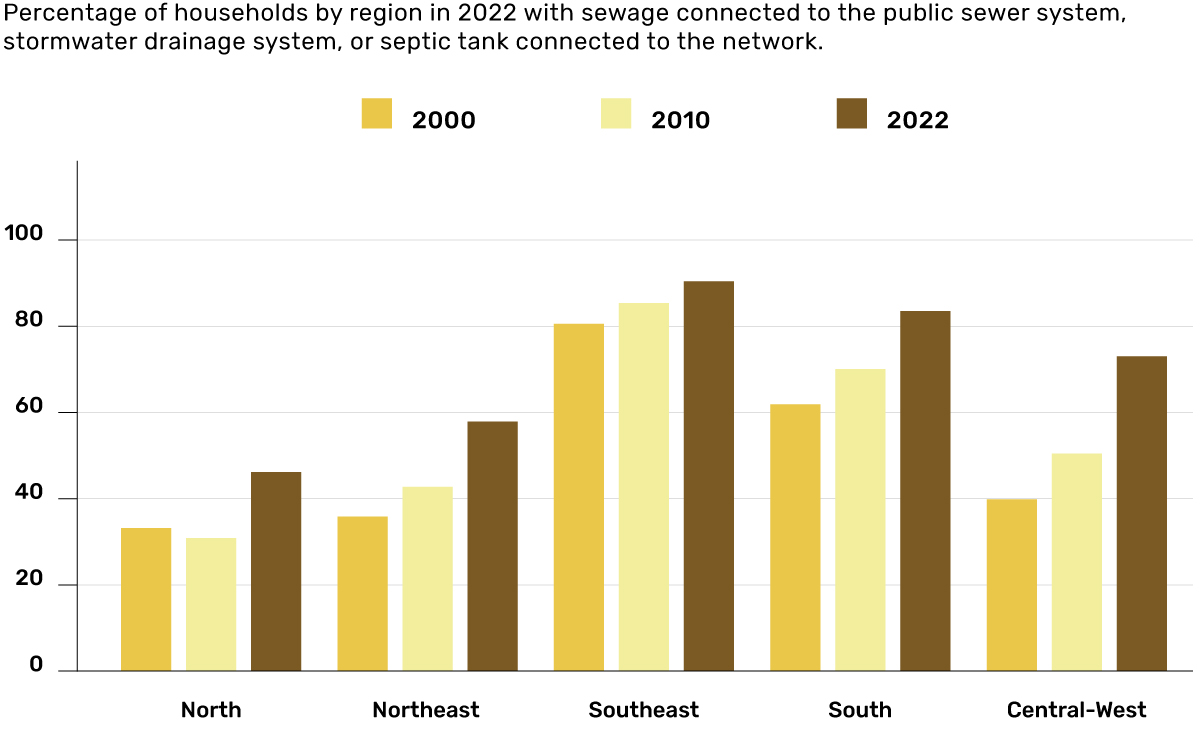
Indigenous peoples move to cities in search of better health conditions, education, and employment opportunities. However, they face persistent challenges, and rampant inequality makes it significantly harder for them to access essential services such as housing, medical care, and drinking water, problems exacerbated by inadequate basic sanitation. As shown in Figure 2, the northern region has the least access to the sewage system in the country. This disparity in access to sanitation is strikingly unequal among different Brazilian demographic groups, with only 29% of Indigenous people living in places with adequate sanitation infrastructure, compared to 83.5% of the white population [7][7] Instituto Brasileiro de Geografia e Estatística. (n.d.). 2022 Census Overview. Retrieved April 17, 2024, from https://censo2022.ibge.gov.br/panorama/.
The Case of Tarumã-Açu
The relationship of the Indigenous inhabitants of Manaus with the Tarumã-Açu basin, located near the city, is emblematic of the environmental and social challenges that traditional communities residing in urban centres have to confront. Situated on the left bank of the Negro River, the largest blackwater river in the world, the Tarumã-Açu basin represents one of the last forested areas within the urban limits of Manaus. It is also home to some of the few remaining clean streams in the city.
Occupying 3.3% of Manaus’s municipal territory, this watershed attracts a diverse range of social groups, from residents of luxury condominiums to social housing communities, indigenous and Afro-Brazilian Quilombola populations, tourists, and industrial workers. Intensifying human activities in the area have caused significant environmental stress [8][8] Costa, J. S. d. (2020). Situation Report: Tarumã-Açu Watershed: Anthropogenic Transformations and Water Quality. Professional Master’s Program in National Network in Management and Regulation of Water Resources (PROFÁGUA), University of the State of Amazonas (UEA), Escola Normal Superior (ENS)..
By 2050, more than half of the global population will live in areas that suffer water scarcity for at least one month each year.
To address water management issues in the city, the Tarumã-Açu Watershed Committee was established in 2009, tasked with developing water management plans and fostering debate and consensus on water use. However, over a decade after its establishment, the Committee has yet to implement an effective water plan for the Tarumã-Açu basin, hampered by insufficient resources and a lack of government support. Additionally, Indigenous leaders are concerned that a new plan for the Tarumã-Açu basin would set rules for the use and management of the river’s water without considering the lifestyle and needs of the riverbank populations.
The Human Right to Water and the Sustainable Development Goals (SDGs)
Water security is a worldwide issue. The quality and quantity of the water we use are closely tied to the health of the ecosystems from which it comes. Nowadays, nearly half of the world’s drinking water sources are facing notable deterioration. Factors like populational growth, climate change, and inadequate planning are intensifying the problem of water scarcity globally. By 2050, more than half of the global population (57%) will live in areas experiencing water scarcity for at least one month each year [9][9] Boretti, A., & Rosa, L. (2019). Reassessing the projections of the World Water Development Report. NPJ Clean Water, 2 (1), Article 15. Available here: https://doi.org/10.1038/s41545-019-0039-9.
Recognising the urgency of this crisis, the United Nations General Assembly and the Human Rights Council officially recognised the human rights to safe drinking water and proper sanitation in 2010. The initiative has had a relative effect. Since 2010, many countries such as Bolivia, Uruguay, and Mexico have assumed the rights of access to drinking water and essential sanitation services, institutionalising them in their constitutions and legal frameworks and promoting access policies. Brazil, however, is still a few steps behind. Despite aligning with UN resolutions and recognising water as a human right, the country lacks constitutional guarantees protecting it. Of the country’s population of just over 215 million, about 32 million still do not have access to treated water, and more than 90 million lack adequate sanitation services [10][10] Instituto Brasileiro de Geografia e Estatística. (n.d.). 2022 Census Overview. Retrieved April 17, 2024, from https://censo2022.ibge.gov.br/panorama/.
Building on these foundational efforts, in 2015, the United Nations (UN) member states adopted the 2030 Agenda, establishing the Sustainable Development Goals (SDGs) to guide global development efforts over 15 years. However, implementing and measuring the progress of SDG achievement presents significant challenges. Effective impact measurement and data collection are crucial, but the lack of complete, high-quality, up-to-date data hampers decision-making and tracking progress. As highlighted in the Seventh Report on the Regional Progress and Challenges of the 2030 Agenda for Sustainable Development in Latin America and the Caribbean, the region has experienced slower progress in meeting these goals than previous years. Globally, UN forecasts suggest that with current trends, only 15% of the SDGs targets will be met by 2030. However, in Latin America and the Caribbean, the Economic Commission for Latin America and the Caribbean (ECLAC) estimates that 22% of the targets have already been met or will be by the deadline [11][11] Economic Commission for Latin America and the Caribbean. (2024). The Challenge of Accelerating the 2030 Agenda in Latin America and the Caribbean: Transitions towards Sustainability (LC/FDS.7/3). United Nations.. These figures reflect a mix of significant achievements and ongoing challenges, underscoring the growing paradox between the increasing relevance of the 2030 Agenda and the rising scepticism towards it. This contradiction thrives amid escalating geopolitical tensions and declining faith in multilateral cooperation.
Western water management principles, which often treat water as a tradable resource, are at odds with Indigenous Peoples’ holistic relationship with their environment.
From an economic point of view, stagnation significantly hinders the ability of Latin America and the Caribbean to pursue sustainable development goals (SDGs). Ineffective economic policies and low investment levels aggravate this scenario, with deep-rooted inequalities and extensive social exclusion restricting equitable access to resources and opportunities essential for achieving the SDGs. Additionally, deficiencies in vital infrastructure areas such as digital connectivity, energy, and transportation, combined with pressing environmental challenges like biodiversity loss, water scarcity, and climate change impacts, present substantial threats to the possibility of a sustainable development in this region.
As mentioned, in addition to these difficulties, the region faces financial constraints, characterised by restricted access to international markets, heavy reliance on foreign investment, and weak institutional and governance frameworks impeding effective SDGs implementation and monitoring. Compounding this problem, escalating debt service costs, driven by global interest rate hikes, significantly restrict fiscal capacity in developing regions, diverting funds from essential investments in climate action and SDG achievement. Higher interest rates intensify the financial pressures on nations and lead to local currency strains, which can result in increased capital flight and the risk of currency depreciation. As a result, many countries worldwide have been identified as at risk of or in debt distress and find themselves compelled to prioritise debt servicing over crucial climate and development initiatives. This predicament traps these nations in a vicious cycle where delayed investments heighten their vulnerability to climate impacts and obstruct broader development goals [13][13] Merling, L., Vasic-Lalovic, I., Valle Cuéllar, L., & Huerta Ojeda, A. (2024). The Rising Cost of Debt: An Obstacle to Achieving Climate and Development Goals. Center for Economic and Policy Research..
Photo_ Luciana Lemos
The discontent with privatised water services has galvanised civil society organisations to push back against the commodification of water resources. During the first UN Global Conference on Water in 46 years, held in March 2023, these groups emphasised the need for new water governance and management models based on solidarity and care. Rejecting market-based approaches promoted by entities such as the World Bank and the Global Commission on the Economics of Water—which advocate for private finance and the commodification of water—these civil society organisations promote prioritising human rights to water and sanitation, non-discrimination, public ownership, and democratic decision-making. They highlight the success of community-based water management systems, particularly in Latin America, where local operators have demonstrated equitable, sustainable, and democratic water governance. These organisations argue that actual progress in water management requires recognising the expertise of local communities and addressing systemic inequalities rather than relying on market-driven solutions that have historically led to adverse social and environmental outcomes [15][15] Heller, L., Karunananthan, M., Zwarteveen, M., Hall, D., Manahan, M. A., & Diouf, F. (2023). What water will the UN Conference carry forward: A fundamental human right or a commodity? The Lancet, 402(10307), 757-759. Available here: https://doi.org/10.1016/S0140-6736(23)01430-7.
New Horizons
Evidence from the privatisation of water services in Manaus underscores that the neoliberal water resource management model has failed to deliver the anticipated outcomes even after more than two decades. This model has allowed companies to establish a regime that excludes many citizens of low economic power, resulting in thousands of users’ lack of access to essential services. Meanwhile, others receive poor-quality services. This approach has perpetuated exclusion and highlighted the precariousness and failures of the privatisation framework.
Nature-based Solutions are vital tools for sustainable urban water management, especially in cities facing the dual pressures of rapid urbanization and climate change.
In this challenging context, it is crucial to consider the complexities faced by President Lula’s current government. Despite its proclaimed support for Indigenous rights, the administration faces significant hurdles, including agribusiness encroachment on ancestral lands, a strong focus on fossil fuel exploitation, and resistance from a right-wing majority in Congress opposed to the demarcation of Indigenous lands. These issues underscore the persistent tension between protecting Indigenous rights and environmental interests against the relentless drive for economic development. Additionally, this tension is further highlighted by Lula’s strategies, which often reveal a conflict between progressive goals and financial realities, especially as Brazil prepares to host COP-30. The country’s international commitments to reduce carbon emissions are at odds with its continued expansion in oil and agribusiness, influenced by powerful lobbying and recent judicial rulings prioritising economic benefits over Indigenous rights and environmental protection.
Despite advocating for global energy transition leadership, the Brazilian government’s investment in new energy technologies remains minimal, highlighting a disconnect between environmental rhetoric and policy implementation. This approach risks a new era of energy dependency and positions Brazil as a contributor to global pollution, contradicting its potential as a leader in sustainable energy. This scenario is exacerbated by immediate environmental crises like severe droughts and floods, showcasing the direct impacts of poor environmental governance. These challenges highlight the need for a unified strategy that aligns Brazil’s economic objectives with its environmental and social responsibilities, ensuring that development does not compromise ecological and human health.
In line with Krenak’s thinking, in a report published in 2022, Pedro Arrojo, the UN Special Rapporteur on Water and Sanitation, acknowledges that the failure to provide clean drinking water to Indigenous peoples constitutes a blatant violation of human rights. The document also highlights that to protect the human rights of Indigenous Peoples when it comes to drinking water and sanitation it is crucial to recognise their knowledge and ensure their active inclusion in the planning and management of water resources [20][20] Human Rights Council. (2022). Human rights to safe drinking water and sanitation of indigenous peoples: state of affairs and lessons from ancestral cultures. Fifty-first session, 12 September–7 October 2022, Agenda item 3. Promotion and protection of all human rights, civil, political, economic, social and cultural rights, including the right to development.. Supporting the discussion, Linton and Pahl-Wostl [21][21] Linton, J., & Pahl‐Wostl, C. (2023). Drawing from indigenous ontologies and practices to Rethink European Water Policy. River Research and Applications. Available here: https://doi.org/10.1002/rra.4126 emphasise the need to realign water policy with fundamental Indigenous values such as relationships, respect, and reciprocity. This shift towards a more relational approach highlights the importance of interactions between communities and water systems in policy and management strategies.
Strategies like these are already in place in various countries around the world. Adopting the Rights of Nature in the 2008 Constitution marked a groundbreaking shift towards acknowledging ecosystems as key stakeholders with legal standing in Ecuador. This move aimed to transform environmental protection by enabling nature to be a subject of legal rights, capable of being represented in court and defended against degradation and exploitation. One notable success of this paradigm shift occurred in 2021 when the Ecuadorian Constitutional Court revoked mining permits in Los Cedros, a cloud forest rich in biodiversity in the Andes. The court ruled that these permits violated not only the rights of residents to clean water and a healthy environment but also the rights of the forest itself. This decision significantly affirms the Rights of Nature, showcasing its potential long-term impact.
In the most threatened ecoregion of the Brazilian Amazon, known as the “arc of deforestation”, forest has drastically been reduced to less than 20% of its original size.
The difficulties in putting the Rights of Nature into practice in Ecuador underline parallel issues related to accessing benefits from using traditional knowledge by Indigenous communities. Despite legal frameworks intended to protect and benefit Indigenous groups for their expertise and cultural contributions, the actual sharing of benefits remains inconsistent and often non-existent. This is partly due to the weak implementation of laws and the limited capacity of Indigenous communities to assert their rights effectively within legal and political arenas dominated by more powerful, resource-rich entities. The gap between legal acknowledgement and practical realisation highlights the need for robust systems that recognise and enforce Indigenous populations’ rights and contributions, ensuring they are central stakeholders in environmental governance [22][22] Etchart, L. (2022). Global governance of the environment, Indigenous peoples and the rights of nature. Springer Nature. Available here: https://doi.org/10.1007/978-3-030-81519-6.
In New Zealand, significant achievements in water management have been achieved by integrating Maori cultural values through the development of cultural assessment tools. These mechanisms are essential in embedding Maori perspectives into water governance, supporting co-governance models that acknowledge water bodies as living entities with legal rights. A notable example is the Whanganui River, granted personhood rights in March 2017. This legal status allows the river to be represented in court by guardians from the Indigenous community and the Crown. This approach, which designates specific guardians for the river, contrasts with broader rights of nature models by focusing on practical and manageable implementations. By granting natural entities personhood one at a time and pairing them with designated guardians, New Zealand is gradually reforming a legal system that traditionally views natural features as property, thus ensuring these entities can advocate for their rights in court [23][23] Stewart-Harawira, M. [Māori], (2020). Troubled Waters: Maori Values and Ethics for Freshwater Management and New Zealand’s Fresh Water Crisis. WIREs Water 7 (5): 1–18..
Finally, in Brazil, several municipalities, such as Florianopolis in Santa Catarina and Guajará-Mirim in Rondônia, recognise natural entities as subjects of rights. In the municipality of Rondônia, the Laje River was recognised as a living entity and subject to rights in 2023. The law was proposed by councilman and Indigenous leader Francisco Oro Waram, from the Indigenous territory surrounding the Laje River region.
The legal framework in Guajará-Mirim not only ensures the existence of the river and all other bodies and beings that live in its waters but also puts it into action. A committee of river guardians was recently established to preserve and maintain these rights. Their responsibilities are comprehensive, from maintaining the river’s natural flow to ensuring sufficient water for the ecosystem’s health. The river is expected to nourish and be nourished by the surrounding riparian forest and endemic biodiversity and to exist with its physical and chemical conditions appropriate for its ecological balance. It must also interrelate with human beings through various activities, including biocultural identification, spiritual practices, recreation, artisanal fishing, and agroecological and cultural activities.
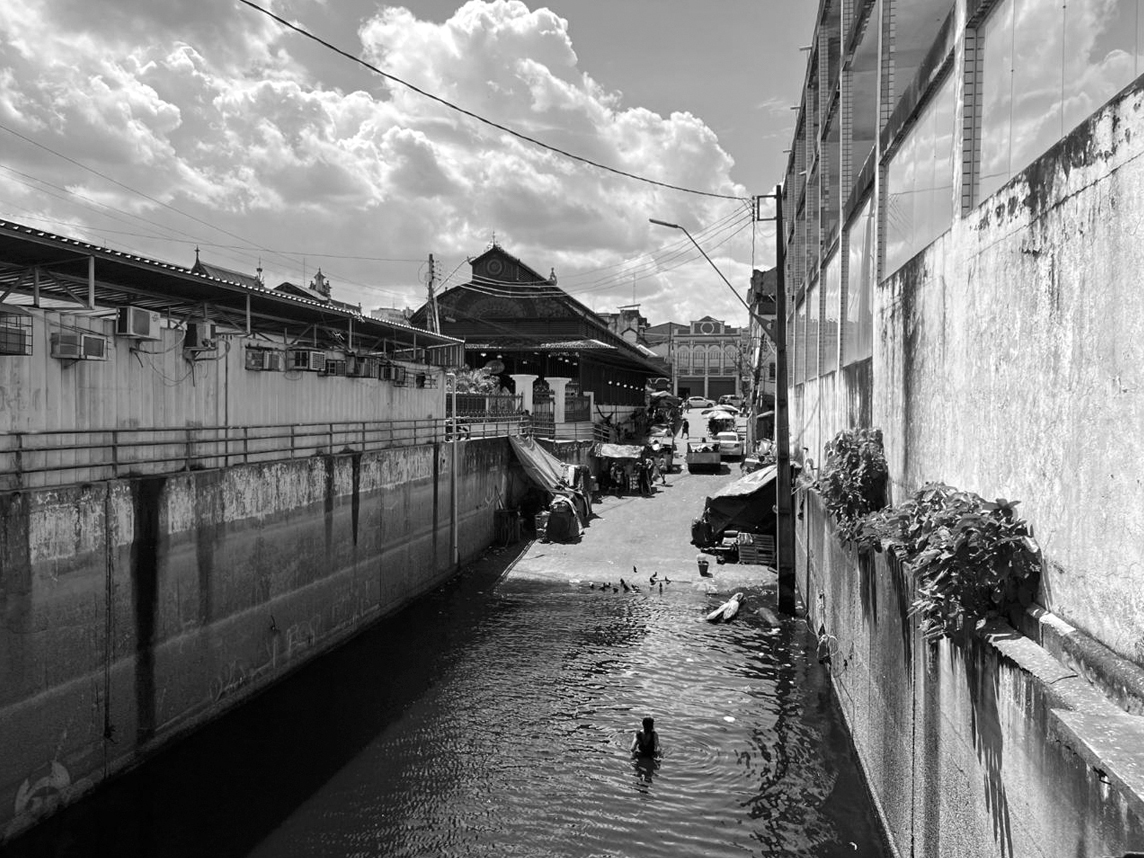
In this way, alongside the efforts of fostering legal frameworks that grant rights to the environment, Nature-based Solutions (NBS) are vital tools for sustainable urban water management, especially in cities facing the dual pressures of rapid urbanisation and climate change. These strategies, which harness the power of natural processes to address various nature-related issues, offer cost-effective and resilient alternatives to technocratic approaches. Urban centres, for instance, have successfully implemented constructed wetlands and riparian buffer zones. These features stabilise banks, reduce pollution runoff, enhance wildlife habitats, and act as natural water filters—thereby improving the ecological health of waterways and increasing landscape connectivity [24][24] United Nations Environment Programme – DHI Centre (2018). NBS primer for water. UNEP-DHI Centre..
Solutions must be culturally appropriate, technically sound, and designed to effectively foster broad community engagement.
As one example of these governance models, the Xingu Hope Spot in the Xingu River basin showcases a complex social-ecological land management system and urbanised landscapes that emerged around 1250-1350 CE. Situated in the most threatened ecoregion of the Brazilian Amazon, known as the “arc of deforestation”, where the process has drastically reduced the forest to less than 20% of its original size, the Upper Xingu River basin is particularly noteworthy. Through participatory mapping and archaeological testing since 1992 with the Kuikuro nation, extensive landscape management practices have been documented, including creating and managing anthropic soils, landscape burning, and advanced water- and fish-management technologies. These practices transformed native forests into cultural forests, demonstrating the significant influence of Indigenous Peoples on biodiversity. In 2017, the Xingu Hope Spot was established in collaboration with Mission Blue and the Puente Institute, along with a cloud-based Geographic Information System (GIS) system for the Kuikuro Indigenous community. This system integrates data from archaeological and cultural heritage mapping to monitor social-ecological variables, showcasing how Indigenous knowledge combined with modern technology can address environmental and health challenges [25][25] Levis, C., Flores, B. M., Campos-Silva, J. V., Peroni, N., Staal, A., Padgurschi, M. C. G., … & Clement, C. R. (2024). Contributions of human cultures to biodiversity and ecosystem conservation. Nature Ecology & Evolution, 8(5), 866-879. Available here: https://doi.org/10.1038/s41559-024-02356-1.
Case studies like this underscore the critical importance of integrating Indigenous Peoples and Local Communities’ wisdom into environmental planning and policy-making. Solutions must be culturally appropriate, technically sound, and designed to foster broad community engagement to mitigate environmental risks effectively. Equally crucial is fostering collaboration between government officials and community members to ensure that all voices are heard and valued. Incorporating decolonial methods, which emphasise care, reciprocity, and solidarity, further enriches this approach, providing a comprehensive and inclusive framework for sustainable development.
This comprehensive strategy offers cities like Manaus a pivotal opportunity to set new standards for urban water management, potentially serving as a model for other Brazilian cities and beyond. Integrating traditional knowledge with contemporary conservation efforts creates harmony between urban development and natural resources. This approach respects ancestral wisdom and leverages it to build resilient communities. Rooted in a holistic view of nature, a framework of care and reciprocity can help “postpone the end of the world”, as Ailton Krenak suggests, by encouraging mutual recognition and sustainable environmental practices. This strategy leads to more effective outcomes and supports the empowerment and resilience of communities, ensuring their active role in shaping their futures.
·
SHARE THIS: